This is not the kind of thickness of PCB that can be simply copied from the previous board and stamped on the next one. Copper weight is a foil specification stating how many ounces of copper are in each square foot of laminate as it comes off the roll, not after plating, cleaning and etching. The inner layers and outer layers each have different process paths and the same ‘1 oz’ note can refer to two different stacks.
The biggest “noise” among the habits that cause people to quote is using “1 oz = 35 μm finished on every layer” to measure the thickness of their prints. The aforementioned ounce figure refers to starting foil. The final product of copper is dependent on the type of layer, the plating and what is left of the etch. When the fabrication drawing doesn’t specify which number you’re after, then current capacity, impedance, fine-trace yield, and cost become guesses.
PCB Copper Thickness vs Copper Weight: What the Numbers Really Mean
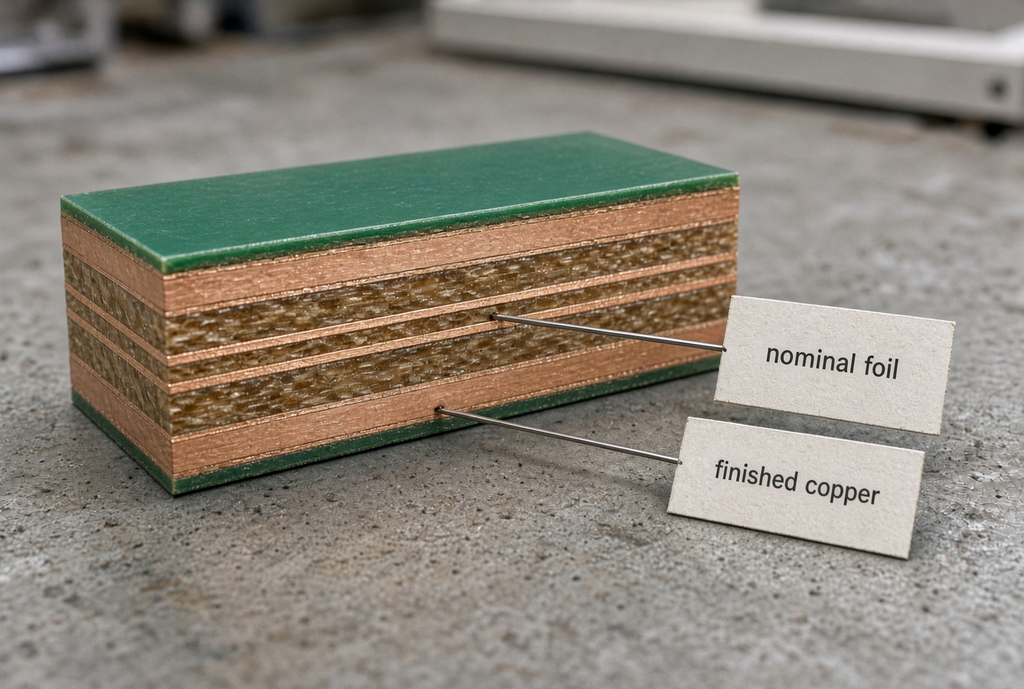
There are three different methods of designating copper in shops, and they can’t be mixed and matched. The unit of purchase for foil is ounce. Weight implies approximately how thin the foil is nominally. After the process sequence for a layer, the remaining material on the board is finished copper.The remainder of the material on the board after the process sequence for a layer is finished copper. The finished number is what is used for all the stack-up impedance, etch yield and current rating, not the catalog ounce on the foil roll.
Nominal Foil, Base Copper, and Finished Copper
The purchased weight of copper on laminate or foil is called nominal foil and is 0.5 oz, 1 oz, 2 oz, etc. Base copper refers to that foil that is on the core or outer laminate before it is plated with the outer layer. Thickness after plating (where applicable), surface preparation and etching.
One mistake, however, is mixing up those words. The word outer” is confusing in the drawing, which should read “1 oz finished outer”, meaning a finished outer that is 1oz copper. The CAM engineer will halt and ask you which one? Do not provide it in chat only, but also in the file.
Why the Fabricator Has to Ask Which Number You Mean
There are two pieces of paper that can read “1 oz” and they can be two different boards. One designer desires 1oz finished on the outside layers, which is done by a combination of thinner starting foil and plating. The other wants 1 oz of foil per layer, including the inners. Those stacks have different etching, impedance, and price.
When the Gerber set is quiet, and the stack-up PDF contains only a single ounce, then the fabricator must make some guesswork. Place the desired starting foil or final target on the drawing, so that the question is answered when the files are dropped.
Copper Weight Conversions Engineers Can Use
When using the weights most commonly used in drawings, 0.5 oz, 1 oz, 2 oz, 3 oz and 4 oz, every number is a nominal weight, and it is necessary to verify it with the foil specification before copying it onto a fabrication drawing.
The minimum finished copper by class and by layer type are specified in IPC acceptability documents. Those minimums are not considered the same as the nominal ounce thickness, and are not reproduced here. Do not use a conversion row as an all-copper guarantee.
Nominal Thickness Table and What It Does Not Promise
Nominal copper-weight equivalents, not finished minimums
| Copper weight (nominal) | Approx. thickness (mil) | Approx. thickness (μm) | What not to assume |
| 0.5 oz | 0.7 mil | 18 μm | That inner and outer layers will finish at 18 μm |
| 1 oz | 1.4 mil | 35 μm | That every layer will measure 35 μm after processing |
| 2 oz | 2.8 mil | 70 μm | That 2 oz foil equals a heavy-copper power board |
| 3 oz | 4.2 mil | 105 μm | That fine spaces and mask dams stay as easy as 1 oz |
| 4 oz | 5.6 mil | 140 μm | That the ounce number is the finished, plated result |
Values are nominal equivalents that are used in regular design discourse. Before they move from the drawing, review the foil specification and fabricator’s process notes.
Inner Layers and Outer Layers Do Not Finish at the Same Thickness
Copper in the inner layers is in the shape of foil around the core. It is not plated (like outer layers are), but is cleaned and etched. The outer copper may begin to be 0.5 oz foil (typical) and be plated before the outer etch. Hence, the “1 oz finished” on an outer layer starts as half-ounce foil.
If a multiply was stamped on each layer, it would obliterate that division. If inner layer and outer layer copper are not actually different starting foils, or different finished targets, they should be described as one copper and not as two.
How to Choose a Copper Weight for Your Board
When selecting the PCB copper weight, it is not a preference list. Run the decision as a fabricator does: continuous current, allowable temperature rise, voltage drop over a long rail, heat spreading into the copper itself, impedance, loss on the layers carrying the controlled traces, and finally, difficulty and cost of etching. Thicker foil is no replacement for a wider trace, a plane or a separate thermal path.
The thickness of copper used in the design of the PCB should be based on the function of the layer. What 4-layer digital board, power rail and controlled impedance pair want most often is a different one on every layer.
When 0.5 oz or 1 oz Is the Normal Choice
The 1 oz. copper is a popular outer-layer finished target used on digital and mixed-signal boards. Starting foil half an ounce is frequently used when fine etch and impedance control are more important than rail current.Half an ounce starting foil, or 0.5 ounces for inner signal layers, is often selected for applications where fine etch and impedance control are more important than rail current.
The problem is that if you duplicate the outer-layer ounce on other signal layers “so the stack is consistent,” then that outer-layer ounce will be duplicated on all other layers below it as well. What you see is not what you get when it comes to consistency in the etch tank. If signals are just going through the inner layers, pushing 1 oz up may be an expense for resolution that was unnecessary.
When 2 oz or Heavier Copper Is Justified
Two-ounce copper is warranted in situations where the continuous current, voltage drop or spreading of heat in plane of that layer is actually required by the circuit—some power circuits, pours in wide areas and high current returns. The 2 oz callout is not an “heavy copper” PCB. 3 oz or more foil increases etch time, width of spaces, and stress of registration and soldermask. It’s not because the boards are required to have 1 oz. that it is the standard upgrade.
Extra ounces are not a substitute for thermal vias or a metal-core structure. These are various heat patterns.
What Gets Harder as the Foil Gets Thicker
Space is becoming tighter, soldermask is added between neighboring copper and as copper increases, tolerance is also tighter. The purchasing lead should get questions from the fabricator about a fine-pitch pattern adjacent to a heavy power pour. That is not a sales objection.
How to Specify Copper Thickness So Fabrication Does Not Guess
A CAM engineer can create from a brief note, which can be controlled. It should at least identify the layer, identify if it is starting foil or finished copper, provide the weight or thickness (with units) and indicate if there is a difference between inner and outer layers. In that case the copper used for the calculation must be the same as the note if it is controlled by the impedance. If the order is influenced by the acceptability class, specify the class. Don’t assume that the shop will take the class you expected, don’t write “standard copper”.
Callout Matrix for Fabrication Data
| Write this in the fabrication data | Do not leave it implied |
| Inner-layer foil weight, layer by layer if they differ | “1 oz throughout” when only the outers were discussed |
| Outer-layer finished copper, or starting foil plus finished target | That outer plating will automatically hit the inner-layer ounce |
| Units when thickness is given in μm or mil | A bare number with no unit and no “starting / finished” label |
| Copper assumed in the impedance model, if impedance is controlled | A stack-up calculator result that never made it onto the drawing |
| IPC class, only if the order requires a named class | “Standard copper” as a substitute for class and thickness |
| Copper-to-edge or heavy-pour notes that change etch | A dense pour next to fine features with no process note |
Where the Number Should Live
Use the stack-up and the fabrication drawing rather than the email and the quote form. One common failure is: the Gerber set doesn’t have a copper note, the stack-up pdf is saying 1 oz, and the portal field is saying 2 oz. The shop now has three sources with no revision to reconcile.
Maintain one controlled note. If the copper changes, update that note. Don’t leave the drawing without not patching the ounce in the chat thread.
Cost and Yield Effects That Do Not Show Up in the Ounce Conversion
More heavier copper can lead to higher costs of the foil and longeretch time. It also increases the risk of a fine space failing. That’s the real side of that ledger: a 1 oz rail that was never enough can cause a board spin that will cost more than the additional ounces will.
Only compare after starting and finished copper layers and minimum space are equal. If two prices appear similar, but one bidder assumed 0.5 oz starting foil and the other bidder assumed 1 oz foil on each layer, then these two prices are not comparable.
Frequently Asked Questions
Is 1 oz copper 35 microns thick on the finished board?
Not automatically. The nominal starting-foil equivalent of one-ounce thickness is generally considered to be approximately 35/1000 of an inch or 35 μm of foil. The finished copper is based on the inner or outer, amount of plating, and what it is that is etched away. Write “1 oz finished” or “1 oz starting foil” so that there is no confusion in the shop about which is which.
What is the difference between copper weight and finished copper thickness?
The ounzes per square foot of copper purchased is the PCB copper weight. After the process sequence, the remaining metal is finished copper thickness. Weight is a purchase and stack up input. Current, impedance and etch rules will see finished thickness.
Should every layer use the same copper weight?
No. Inner layers are usually foil which has been etched at the location. Often outer layers are constructed using starting foil of a lower thickness and the completed target is plated. Different weights can be used on the same board if it is used for signal layers, planes, and power pours. This is only a documentation short-cut; it is not a design rule.
Does thicker copper always carry more current?
A thicker copper has a lower resistance for a given trace width; thus it will be able to carry more current for the same temperature rise. The width, length, copper connected to the trace, ambient conditions and temperature rise remain the primary factors. Extra ounces will not be used to create a wider trace or plane if one is needed by the current path.
How should copper thickness be written on a fabrication drawing?
Name the layer (e.g. starting foil or finished copper); specify the weight or thickness in units and separate the inner and outer layers if they are different. State the copper used in a model if there is control of impedance. If there is a named IPC class, record the class. Place that note on the stack-up and fabrication drawing and update the note if the copper changes.
When is a heavy-copper PCB the right question, rather than a 2 oz callout?
Request heavy-copper construction on the board when it is meant to carry a high continuous current or thick power metal as a product, not when only 2 oz will be used on selected pours, while the remainder of the stack is of standard thickness. This is a callout for 2-ounce foil on a digital or mixed-signal board. A heavy copper PCB is another construction discussion, and has other etch, spacing and mask expectations.